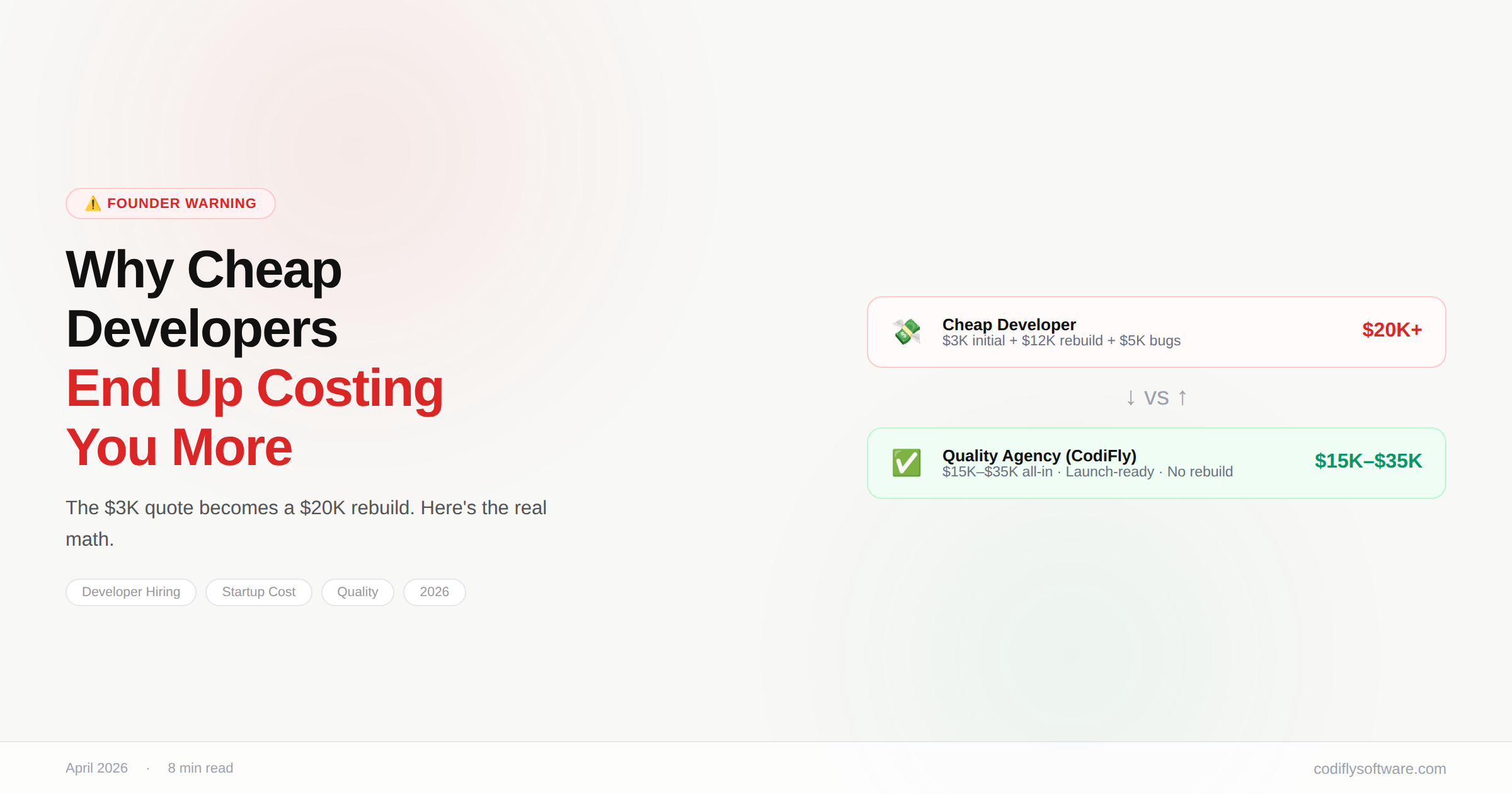
Why cheap developers end up costing you more
The $3K MVP quote is tempting. But when you factor in rewrites, bug fixes, missed deadlines, and lost users — the cheapest option almost always becomes the most expensive. Here's what actually happens, and how to hire affordably without the hidden costs.
The pattern every founder recognises too late
It starts the same way almost every time. You post your project on a freelance platform, get 15 proposals, and pick one of the cheaper options. The developer seems competent, the portfolio looks okay, and the quote is $3K–$5K for your entire MVP. Great deal.
Three months later: the project is half-finished, riddled with bugs, the code is unmaintainable, and the developer has gone quiet. You hire someone else to finish it — but they take one look at the codebase and say it needs to be rebuilt from scratch.
Your $3K MVP has now cost $15K–$20K, taken 6 months instead of 3, and you still don't have a product you can show to users or investors.
The real math: cheap vs affordable
| Cost factor | Cheap developer ($3K–$5K) | Quality agency ($15K–$35K) |
|---|---|---|
| Initial build | $3,000–$5,000 | $15,000–$35,000 |
| Bug fixes (6 months) | $5,000–$10,000 | $500–$1,500 (included in support) |
| Rebuild probability | 60–70% need full rebuild | Under 5% |
| Rebuild cost | $12,000–$25,000 | N/A |
| Time to launch | 4–6 months (with delays) | 10–14 weeks |
| Total cost (12 months) | $20,000–$40,000 | $16,000–$37,000 |
| Product quality | Unusable or barely functional | Launch-ready, investor-grade |
The "cheap" option costs the same or more over 12 months — and you end up with a worse product that launches later. The agency isn't cheaper because it charges less per hour. It's cheaper because it does the job once, correctly, and on time.
Red flags to watch for when hiring
- No discovery phaseIf they quote your project without asking detailed questions about scope, user flows, and technical requirements — they're guessing. A proper estimate requires 3–5 hours of analysis minimum.
- The quote is 50%+ below everyone elseIf three agencies quote $20K–$30K and one quotes $5K, the cheap one isn't more efficient — they're cutting corners you can't see yet.
- No portfolio with comparable projectsAsk to see live, working products they've built — not just screenshots. Click around. Check if the apps actually work.
- No process describedIf they can't explain their development process (sprints, demos, QA, deployment), they don't have one.
- "I can do everything"One person claiming to be an expert in design, frontend, backend, mobile, and DevOps is a red flag. Nobody is great at all of those.
How to hire affordably without going cheap
- Hire an Indian agency with a proven track recordIndia-based teams charge $20–$50/hour vs $100–$200/hour for US teams — a 60–70% cost saving with comparable quality. The key is vetting: check portfolios, speak to past clients, and start with a small paid project.
- Start with a paid discovery phaseSpend $1,500–$3,000 on a proper scope document before committing to the full build. If the agency can't deliver a good discovery, don't trust them with $20K of development.
- Insist on milestone-based paymentsNever pay 100% upfront. Pay per completed milestone with clear deliverables. This aligns incentives and protects your investment.
- Demand biweekly demosSee working software every two weeks. If progress isn't visible, you catch it in week 2 — not month 4.
CodiFly's approach: affordable ≠ cheap
CodiFly is an India-based agency, which means our rates are 60–70% lower than US/UK agencies. But we're not cheap — we're affordable. The difference:
Every engagement starts with discovery. We don't quote without understanding your product. Milestone payments with biweekly demos mean you see progress constantly. Dedicated QA means bugs are caught before launch, not after. Full documentation and source code ownership means you're never locked in.
Typical CodiFly MVP: $15K–$35K, 10–14 weeks, launch-ready. That's less than what most founders end up spending on cheap developers after the rebuild — and you get a product you can actually put in front of investors and users.
"The bitterness of poor quality remains long after the sweetness of low price is forgotten."
Done with cheap development? Let's build it right.
Whether you're starting fresh or rebuilding after a bad experience — CodiFly delivers quality MVPs on realistic budgets.
Get your free estimate →