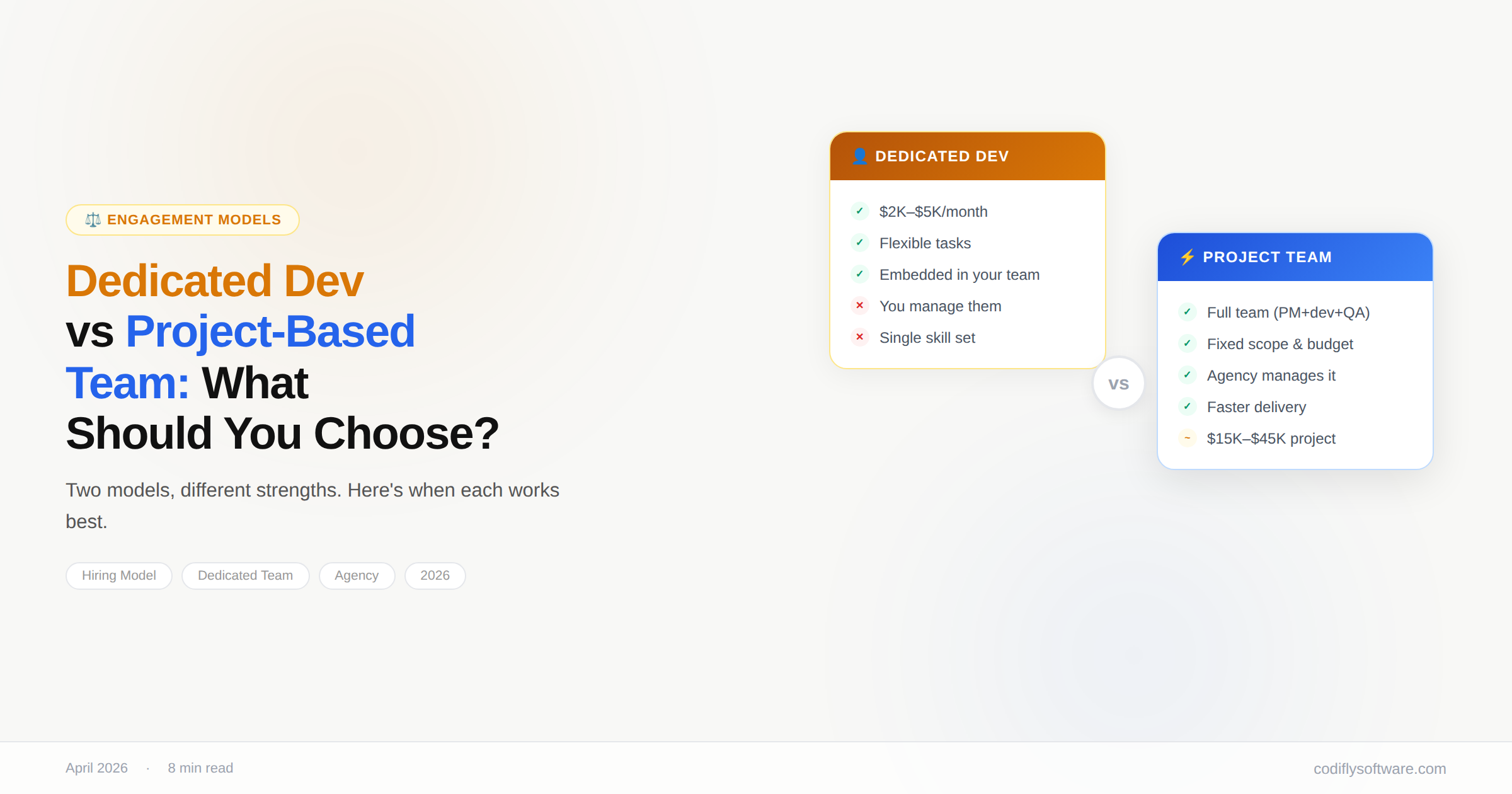
Dedicated developer vs project-based team: what should you choose?
Two different engagement models, two different outcomes. Dedicated developers give you ongoing capacity. Project-based teams give you complete, structured execution. Here's when each works best — and when to combine them.
The two models explained
A dedicated developer is an individual (or small team) hired on a monthly basis to work exclusively on your project. You manage their tasks, set priorities, and direct their work. Think of it as hiring a remote employee — without the HR overhead.
A project-based team is a full agency squad (PM, designer, developers, QA) engaged for a specific deliverable with a defined scope, timeline, and budget. They manage themselves — you review progress and provide direction at a higher level.
Both are legitimate models. The right choice depends on what you're building, how much management you can provide, and where you are in your product lifecycle.
When each model makes sense
- ✓ You have an existing product that needs ongoing work
- ✓ You're a technical founder who can manage developers
- ✓ You need flexibility — tasks change week to week
- ✓ You want someone embedded in your workflow (Slack, standups)
- ✕ You need a full team (design + dev + QA)
- ✕ You're building from scratch with no tech lead
- ✓ You're building a new product (MVP, V2, mobile app)
- ✓ You're a non-technical founder who needs guided execution
- ✓ You want a fixed scope, timeline, and budget
- ✓ You need design + frontend + backend + QA as a package
- ✕ You have highly variable, unpredictable work
- ✕ You want to change direction every week
Side-by-side comparison
| Factor | Dedicated developer | Project-based team |
|---|---|---|
| Pricing | $2K–$5K/month per developer | $15K–$45K fixed for the project |
| Skill coverage | 1–2 skills per person | Full stack (design, dev, QA, PM) |
| Management required | High — you're the PM | Low — PM handles it |
| Best for | Ongoing feature work, maintenance | New builds, MVPs, complete products |
| Budget predictability | Monthly burn rate (variable scope) | Fixed budget with defined deliverables |
| Flexibility | Very high — change tasks anytime | Moderate — scope is defined upfront |
| Accountability | You own the outcome | Agency owns the deliverable |
| Speed | Depends on individual capacity | Faster — parallel execution |
The hybrid approach
Many of CodiFly's clients use both models at different stages:
Phase 1 — Project-based: CodiFly builds the MVP as a complete project ($15K–$35K, 10–14 weeks). Scope is defined, timeline is fixed, deliverable is a launched product.
Phase 2 — Dedicated developer: After launch, a CodiFly developer joins on a monthly retainer ($2K–$5K/month) for ongoing feature development, bug fixes, and iterations. You manage priorities; they execute.
Phase 3 — Transition: When you hire your first in-house engineer, CodiFly does a full knowledge transfer and the dedicated developer phases out. Clean handoff, no lock-in.
CodiFly offers both — here's how
Unlike agencies that only do project work or staffing firms that only place individuals, CodiFly offers both engagement models — and can seamlessly transition between them:
Project-based: Full team (PM, designer, 1–2 devs, QA). Fixed scope and timeline. Milestone payments. Biweekly demos. $15K–$45K depending on complexity.
Dedicated developer: Senior full-stack developer (React/Node or Python/Django), available 40 hours/week, embedded in your tools (Slack, Jira, GitHub). $2,500–$4,500/month.
Hybrid: Project-based build → dedicated developer retainer. Seamless transition, same team, no context loss.
"The best engagement model is the one that matches your current needs — not the one that's easiest for the agency to sell."
Not sure which model fits? Let's figure it out together.
Tell us about your project and stage — we'll recommend the right engagement model, whether that's project-based, dedicated, or hybrid.
Get a recommendation →