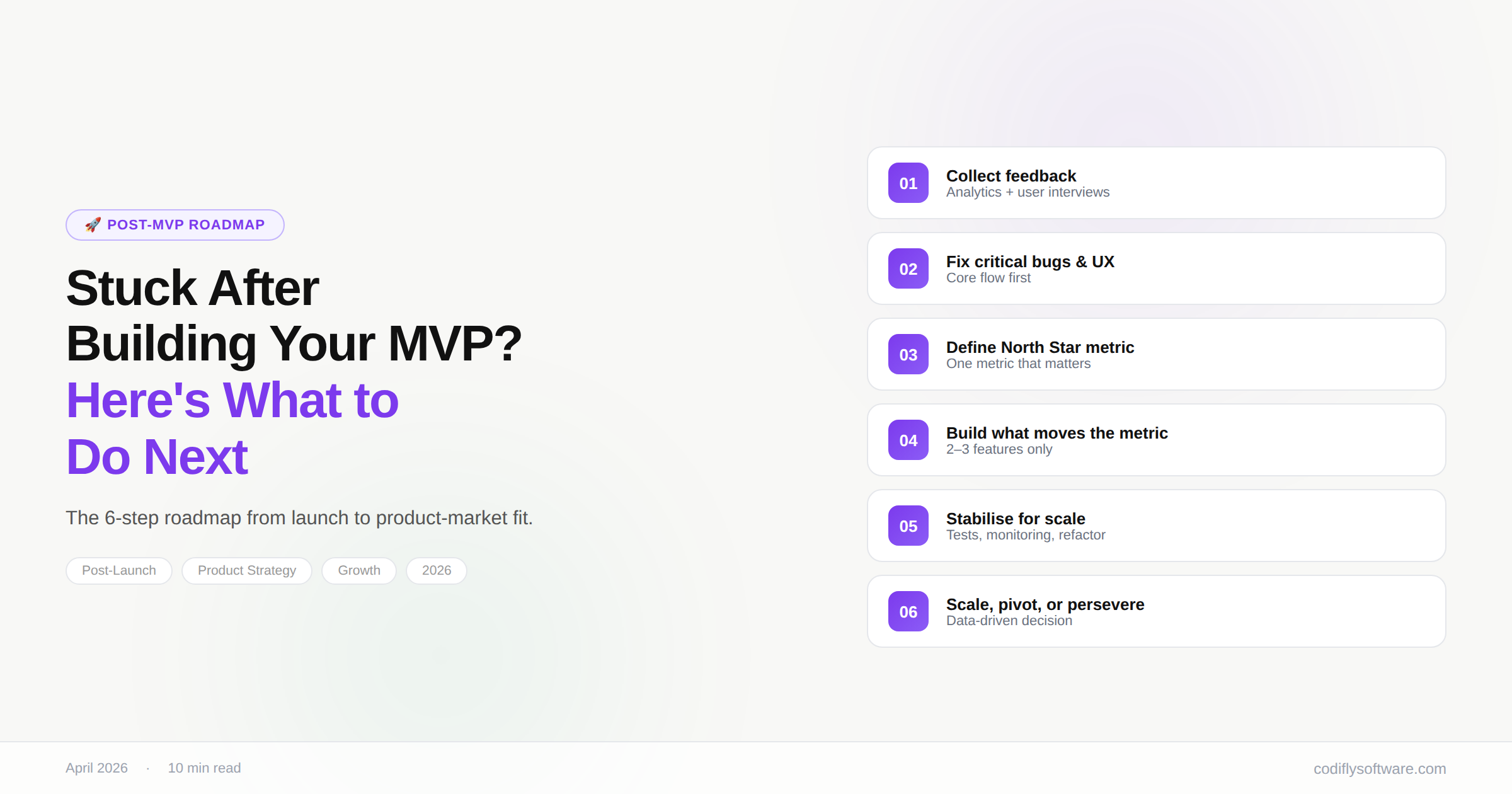
Stuck after building your MVP? Here's what to do next
You launched your MVP. Users signed up. Now you're staring at a dashboard of feedback, feature requests, and bugs — unsure what to prioritise. This is the most critical and most confusing phase of any startup. Here's the roadmap.
Why the post-MVP phase is so hard
Building the MVP was the hard part — or so you thought. The truth is, launching is just the beginning. The post-MVP phase is where startups either find product-market fit or quietly die.
The challenge: you now have real users, real data, and real feedback — but it all pulls you in different directions. Users want 15 different features. Investors want to see growth. Your codebase needs stability. And your budget isn't infinite.
The founders who succeed at this stage are the ones who prioritise ruthlessly, iterate fast, and resist the urge to rebuild everything from scratch.
The 6-step post-MVP roadmap
Set up proper feedback channels: in-app feedback widgets, user interviews (even 5–10 are enough), support emails, and analytics (Mixpanel or PostHog). Categorise everything into three buckets: bugs (fix immediately), usability issues (fix this month), and feature requests (evaluate later).
Before adding any new features, fix everything that stops users from completing the core flow. If users can't sign up, can't complete a purchase, or can't understand how to use the main feature — that's what you fix first. New features on a broken foundation are wasted effort.
Pick ONE metric that measures whether your product is delivering value. For a marketplace: completed transactions. For a SaaS tool: weekly active users. For a content platform: time spent or return visits. Every decision from this point should serve this metric.
You'll have 50 feature requests. Build the 2–3 that directly impact your North Star metric. Everything else goes to the backlog. This is the hardest discipline — saying no to good ideas because they're not the most important idea right now.
If you cut corners during the MVP (everyone does), now is the time to pay down technical debt. Improve test coverage, refactor fragile code, set up proper monitoring, and ensure the infrastructure can handle 10x your current traffic. Don't rebuild — refactor incrementally.
By now you have enough data to make a big decision. Are users retaining? Is the metric growing? If yes — invest in growth (more features, marketing, hiring). If no — pivot the approach, not necessarily the idea. If maybe — keep iterating with a tighter focus.
Mistakes that kill post-MVP momentum
- Rebuilding instead of iteratingYour MVP codebase isn't perfect. That's fine — it's not supposed to be. Resist the urge to rewrite everything. Refactor incrementally while shipping new features.
- Building every feature users requestUsers tell you what they want, not what they need. Prioritise features that serve your core hypothesis, not features that make one vocal user happy.
- Losing your development teamIf the agency that built your MVP is gone and you haven't hired anyone — you're stuck. Maintain continuity: either keep the agency on retainer or hire your first engineer before the agency disengages.
- Ignoring analyticsShipping features without measuring impact is flying blind. If you don't know which features drive retention, you're guessing — and guessing is expensive.
How CodiFly helps after launch
CodiFly doesn't just build your MVP and walk away. Our post-launch support model is designed for the critical first 6 months:
Retainer model ($2K–$5K/month): A dedicated developer + PM available for bug fixes, feature iterations, and infrastructure maintenance. You get consistent velocity without hiring full-time.
Sprint-based iteration: For bigger feature pushes, we run 2-week sprints with clear deliverables. You prioritise the backlog; we execute.
Scale-up path: When you're ready to build an in-house team, we do a full knowledge transfer — documented codebase, architecture walkthrough, and a transition period. No lock-in, no hostage code.
"Your MVP isn't the finish line — it's the starting line. What you do in the next 90 days determines everything."
Launched your MVP and need what comes next?
CodiFly's retainer model gives you consistent development velocity without full-time hiring costs.
Talk to us about post-launch support →