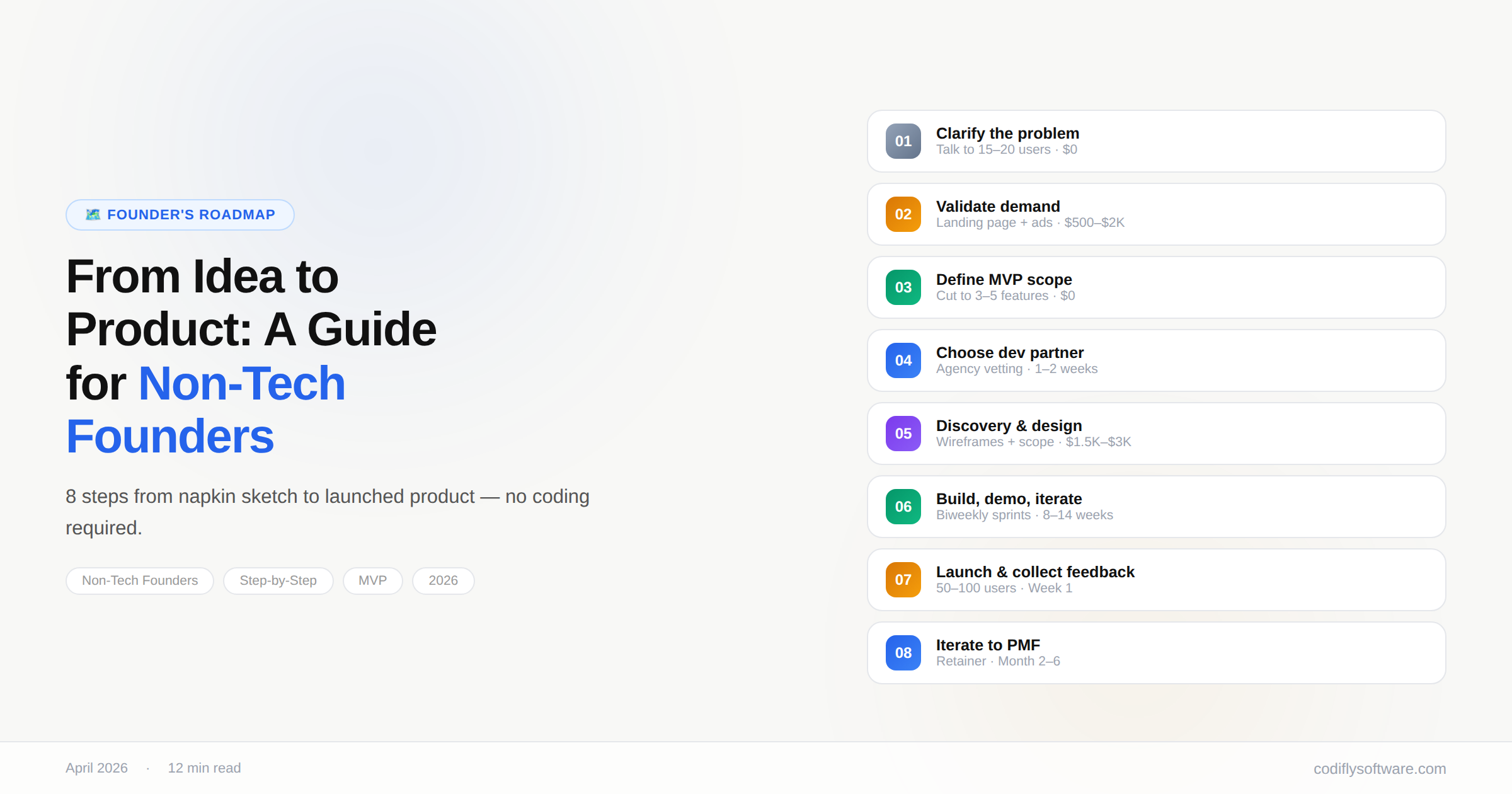
From idea to product: a step-by-step guide for non-tech founders
You have a great product idea but no technical background. No CS degree, no coding skills, no CTO. This guide walks you through every step — from napkin sketch to launched product — so you know exactly what to do, what to spend, and who to hire at each phase.
Most founders start by describing their solution: "I want to build an app that does X." Instead, start by defining the problem: "People struggle with Y, and the current options are Z." Talk to 15–20 potential users. Ask them what frustrates them, how they currently solve the problem, and what they'd pay for a better solution. If you can't articulate the problem clearly, you're not ready to build.
Build a simple landing page describing your product (use Webflow or Framer — $29/month). Add a "Join the waitlist" button. Run $500 in Google/Meta ads targeting your audience. If 50+ people sign up in a week, you have signal. If nobody cares, you've saved yourself $15K+ in development costs. This step is non-negotiable.
Write down every feature you imagine. Now cut 80% of them. Your MVP needs 3–5 features that let a user experience the core value proposition. Not the full vision — just enough to test whether people will use it and pay for it. Everything else is Phase 2.
Ask yourself: "If the app only did ONE thing, what would that thing be?" Start there.
As a non-technical founder, you need a team — not a freelancer. You need someone who can translate your vision into wireframes, architecture, and working software. Look for an agency that starts with a discovery phase, shows biweekly demos, works on milestone payments, and has built products similar to yours.
CodiFly works with non-technical founders regularly. Typical engagement: $15K–$35K for a complete MVP, delivered in 10–14 weeks, with design, development, QA, and deployment included.
A good agency will run a paid discovery phase before writing any code. This includes: mapping user flows, creating wireframes, defining the technical architecture, and producing a detailed scope document with timeline and cost. At the end of discovery, you should have a crystal-clear picture of what's being built, how long it takes, and what it costs.
Development happens in 2-week sprints. Every two weeks, you see working software — not mockups. You test it, give feedback, and the team adjusts. This cycle ensures the product stays aligned with your vision and prevents the "I paid for 3 months and got something I didn't want" disaster.
Your job during this phase: Stay close to the process. Review every demo. Talk to potential users. Don't disappear for 6 weeks and expect magic.
Don't overthink the launch. Share it with your waitlist, post on Product Hunt, share in relevant communities, and reach out to your user interview contacts. The goal isn't to go viral — it's to get 50–100 real users who will give you honest feedback.
This is where the real work begins. Fix bugs, improve UX, add the 1–2 features users actually need (not the 15 they suggest), and watch your metrics. Are users coming back? Are they paying? Are they recommending it? When the answer is yes to all three, you've found product-market fit.
CodiFly offers a post-launch retainer ($2K–$5K/month) to keep development velocity going without the cost of full-time hires.
"You don't need to learn to code. You need to learn to communicate your vision clearly — and hire people who can execute it."
Have an idea? Let's turn it into a product.
CodiFly specialises in working with non-technical founders — from first conversation to launched MVP.
Start your journey →