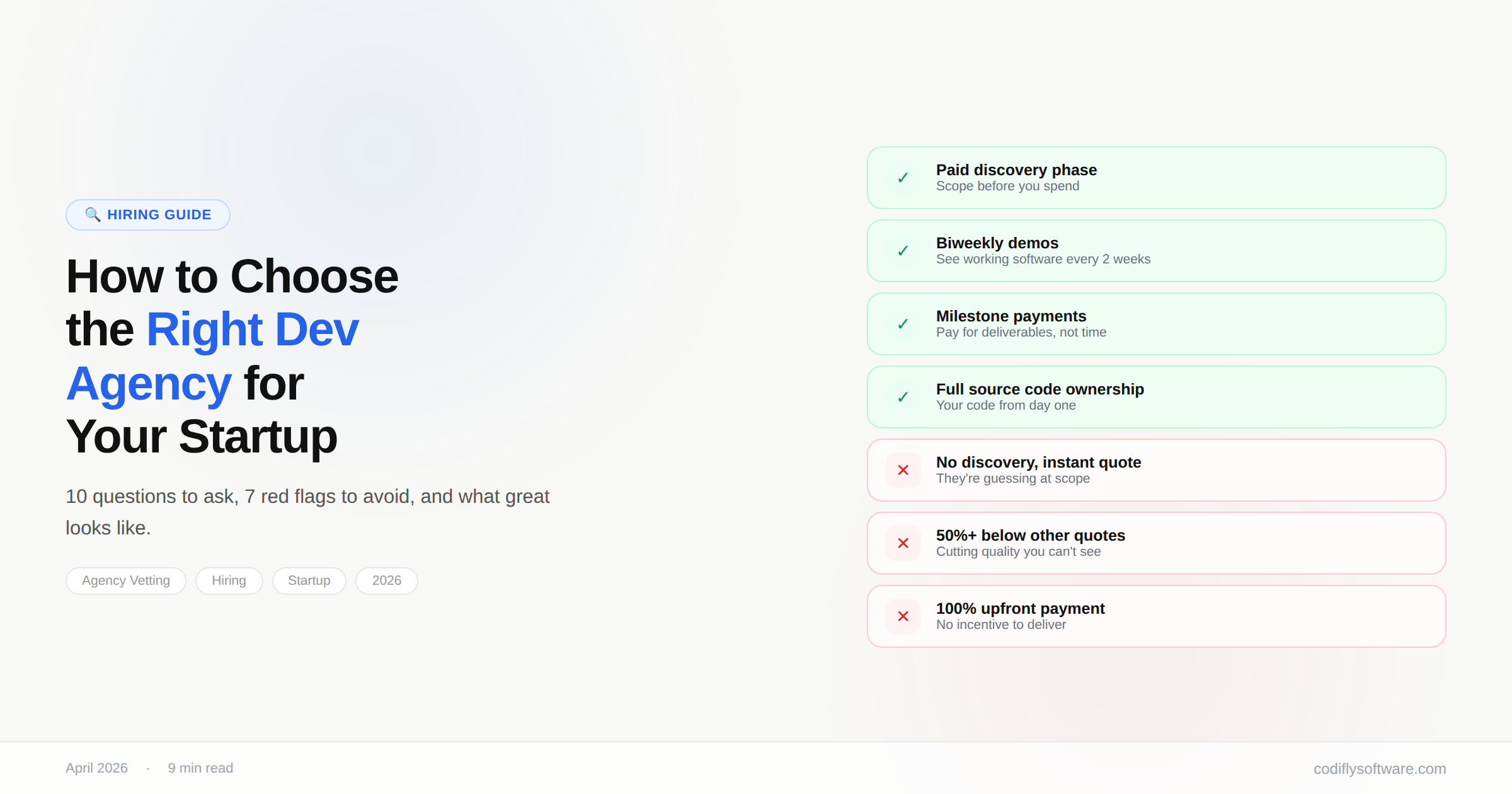
How to choose the right development agency for your startup
Hiring the wrong agency wastes 3–6 months and $10K–$50K. This guide gives you a practical vetting framework — 10 questions to ask, 7 red flags to avoid, and what a great agency engagement actually looks like.
Why the right agency matters more than the right price
Three agencies quote $20K, $35K, and $50K for the same project. Most founders pick the cheapest. But a $20K engagement that delivers a broken product you need to rebuild costs more than a $35K engagement that ships a working product on time.
The right question isn't "who's cheapest?" — it's "who will deliver a product I can actually launch?" Price matters, but process, communication, and track record matter more.
10 questions to ask before signing with any agency
- "Can I see live products you've built?"Not screenshots — actual working apps. Open them, click around, check if the UX is solid. If they can't show live products, they may not have built any.
- "Do you start with a discovery phase?"If they quote your full project without a discovery phase, they're guessing at scope. A good agency spends 1–2 weeks understanding your product before committing to a number.
- "How do you handle payments?"The right answer: milestone-based. You pay for completed deliverables, not time. Avoid 100% upfront or vague "monthly retainer before we start" models.
- "How often will I see working software?"The right answer: every 1–2 weeks. If they say "at the end of the project," that's a huge risk.
- "Who will I communicate with day-to-day?"You should have a dedicated PM — not the developer. If you're managing the developers yourself, you're not paying for an agency; you're paying for freelancers with a fancier invoice.
- "Do I own the source code?"The answer should be an unequivocal yes. Full ownership, from day one, hosted on your repository.
- "What happens if we need to part ways mid-project?"A good agency has a clear exit clause: you keep the code, documentation, and any completed work. No hostage situations.
- "What's included in QA and testing?"If QA is "extra" or "optional," expect bugs in production. QA should be built into every sprint, not bolted on at the end.
- "Can I talk to 2–3 past clients?"If they hesitate, that's a red flag. Good agencies are proud of their client relationships.
- "What post-launch support do you offer?"Launching is just the beginning. Ask about retainer models, bug-fix SLAs, and how they handle the critical first 3 months after launch.
7 red flags that predict a bad engagement
- They quote without asking detailed questionsIf the agency provides a final price after a 30-minute call, they don't understand your project. Good estimates require days of analysis, not minutes.
- Their price is 50%+ below everyone elseThree quotes at $25K–$35K and one at $8K? The $8K agency is cutting scope, quality, or both. You'll pay the difference later in bug fixes and rebuilds.
- No defined processIf they can't describe their development workflow (sprint cycles, demo frequency, QA approach), they're winging it.
- "We do everything"An agency that claims expertise in web, mobile, AI, blockchain, VR, IoT, and marketing is an expert in nothing. Look for specialised teams, not generalists.
- No live products in their portfolioMockups and screenshots don't prove execution ability. If every portfolio item is a design concept, they may not have shipped real products.
- They push 100% upfront paymentAny legitimate agency offers milestone-based payments. Demanding full payment upfront removes their incentive to deliver.
- They refuse to provide referencesIf past clients won't vouch for them, that tells you everything you need to know.
What a great agency engagement looks like
- Paid discovery (1–2 weeks)Detailed wireframes, user flows, technical architecture, and a fixed-scope estimate. You pay $1,500–$3,000 and get a document you can take to any agency.
- Biweekly demos with working softwareEvery 2 weeks, the PM walks you through new features in a live environment. You click, you test, you give feedback.
- Milestone-based paymentsYou pay when deliverables are met. If a milestone isn't completed, you don't pay. Simple.
- Clean handoff and full ownershipSource code on your GitHub from day one. Documentation, architecture diagrams, and a README that any new developer can follow.
- Post-launch support2 weeks of bug fixes included. Retainer available for ongoing development. Transition support when you hire in-house.
CodiFly's vetting checklist — applied to ourselves
We built this vetting framework based on what we wish founders would ask us. Here's how CodiFly stacks up against our own criteria:
✅ Live products in portfolio — we share links to real, working apps. ✅ Paid discovery phase before every engagement. ✅ Milestone-based payments as default. ✅ Biweekly video demos with working software. ✅ Dedicated PM for every project. ✅ 100% source code ownership from day one. ✅ Clean exit clause in every contract. ✅ QA included in every sprint. ✅ Client references available on request. ✅ Post-launch retainer model available ($2K–$5K/month).
Ready to vet CodiFly?
Start with a conversation. We'll answer every question on this list — and show you live products we've built.
Start the conversation →