We'll get back to you within 24 hours with a tailored plan.
✓
Enquiry Received!
Thanks! Our team will reach out within 24 hours to discuss your project. Check your inbox for a confirmation.
Custom ERP software development
Your Business Has Its Own Way of Working. Your Software Should Too.
We design and develop custom ERP software to help growing businesses manage orders, inventory, quotations, payments, and daily operations in one connected platform.
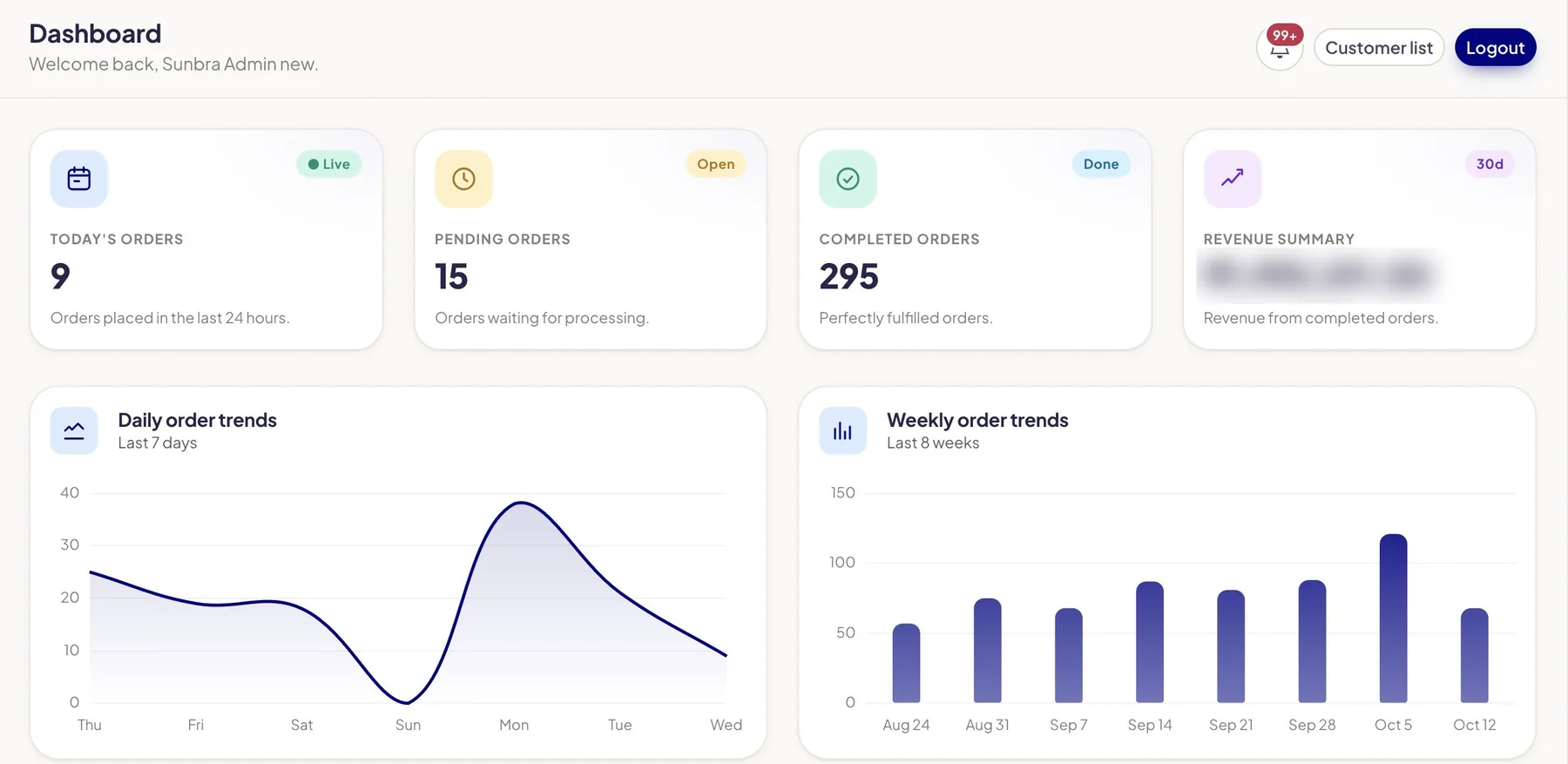
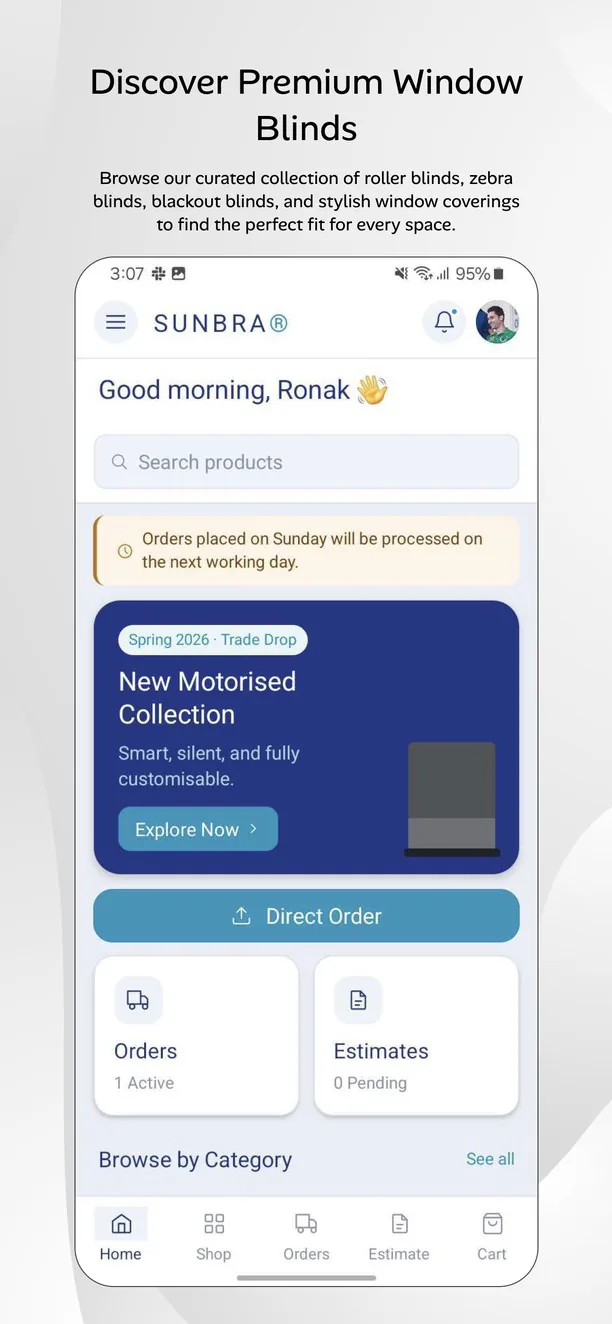
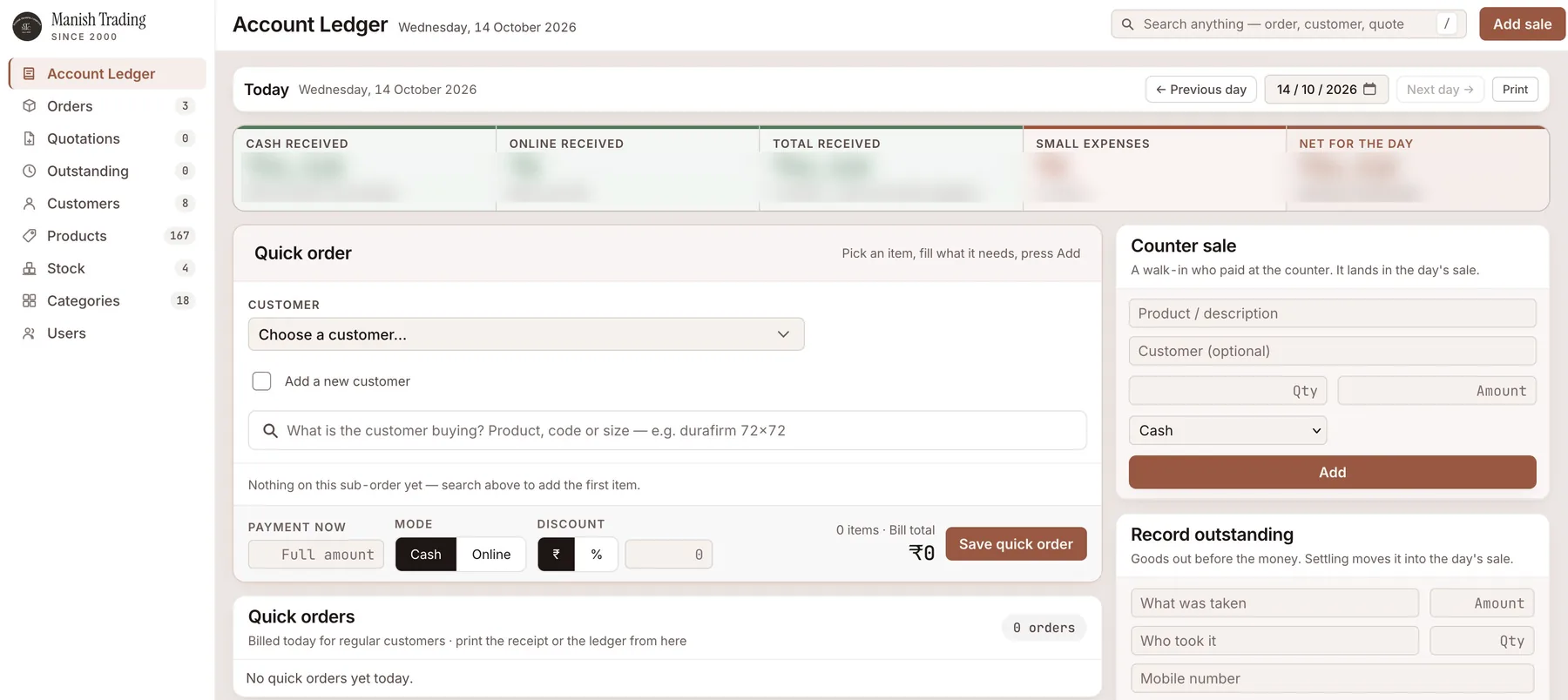
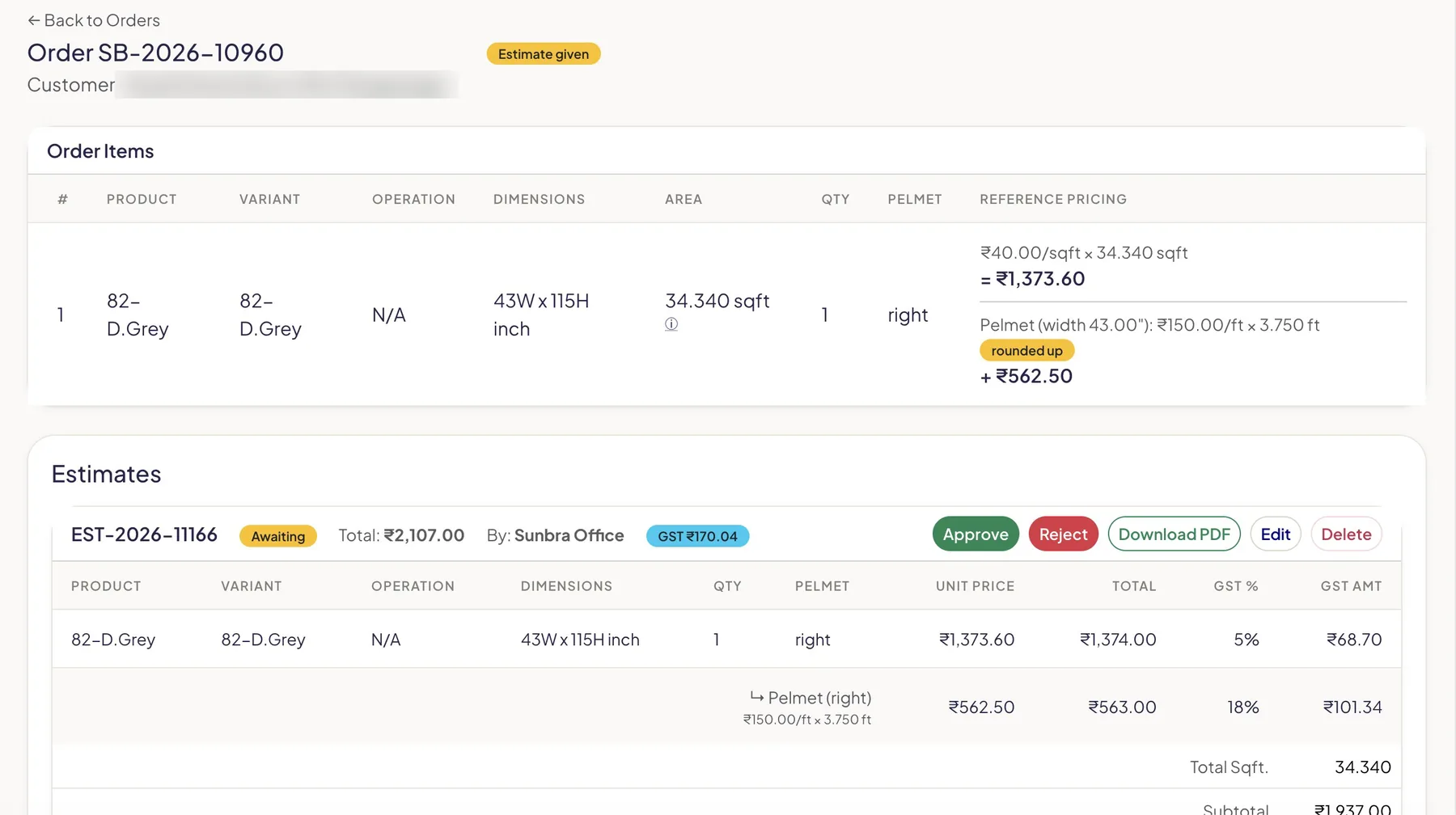
Real screens from the Sunbra Blinds platform we built: the web admin dashboard and the dealer app. Revenue figures are blurred.
Still Managing Important Business Processes Across Different Tools?
Most growing businesses don't start with a system. They start with a spreadsheet, a notebook and a WhatsApp group, and it works until the business gets busier.
Information in too many places
Customer details, rates and order notes are spread across spreadsheets, notebooks and chat threads, so finding the latest version takes time.
Quotes and invoices made by hand
Each quotation or bill is typed or calculated manually, which is slow and easy to get wrong when prices depend on size, unit or tax rate.
Unclear customer balances
When orders are paid in parts, it becomes hard to say who owes what without going back through receipts.
Stock that is out of date
Stock is updated when someone remembers, so the team can't always trust what the sheet says is available.
Orders without a clear status
An order moves from sales to production or dispatch, but nobody can see at a glance where it is or who has it.
Little visibility for the owner
Getting a picture of today's sales, pending orders or cash in hand means asking around or waiting for someone to compile it.
The solution
One Connected System, Designed Around Your Business
We start with how your business works today, then build a system for those workflows: your products, your pricing rules, your approval steps and your reports. Each record (a customer, an order, a payment) is entered once and used everywhere it is needed.
These are building blocks, not a fixed package. Which modules you get depends on the scope we agree with you, and nothing here comes bundled at a fixed price.
Capabilities we can build
Customer and supplier management
Sales and purchase orders
Quotations and invoices
Inventory and product variants
Order and fulfilment tracking
Payments and outstanding balances
Business reports and dashboards
Role-based access
Multi-branch workflows, where required
Mobile apps or dealer portals, where required
Third-party integrations, where feasible
Use cases
Built for How Your Industry Works
ERP for Trading & Distribution
For traders, wholesalers and distributors who sell from a catalogue, supply large orders in batches and collect payment in parts.
Quotations that convert into orders
Product catalogues with variants and units of sale
ERP (enterprise resource planning) software keeps a business's core records, such as customers, products, orders, stock, invoices and payments, in one connected system. Custom ERP is built around one business's own processes instead of asking the business to adapt to a ready-made product. For a small or medium business it is usually a focused system covering the workflows that matter most, not a large suite.
How is custom ERP different from off-the-shelf software?
Off-the-shelf software is quicker to start with and is paid for as a licence or subscription, but its features are designed for many businesses and can be hard to change. Custom software is designed around your workflows, pricing rules and permissions, and you decide what it does next. In return it needs an upfront investment, time from your team during planning, and ongoing maintenance. Many businesses are well served by ready-made tools; custom software makes sense when important workflows don't fit them.
Can you build software around our existing process?
Yes, that is where we start. During discovery we look at how you work today, including the spreadsheets, forms, documents and messages your team relies on, and design the system around it. If we see steps that could be simplified we will suggest them, but the decision stays with you.
Can we start with a few modules and expand later?
Yes. Starting with the workflows that cause the most trouble is often the practical choice. We plan the first version so that further modules can be added later without starting again.
Can the system work on mobile?
Yes. Systems can be built as web applications that work on phones and tablets, and where it is needed we also build native Android and iOS apps. The Sunbra Blinds dealer app, for example, runs on both Android and iOS alongside a web admin panel.
Can you migrate data from Excel or an existing system?
Usually, yes. Customer lists, product catalogues, price lists and opening balances kept in Excel or exported from another system can generally be imported once they have been cleaned up. The effort depends on how much data there is and how consistent it is, so we review samples during planning before estimating this part.
Can you integrate existing accounting, payment, or third-party tools?
Often, yes, when the other tool offers an API or a supported import and export format. Some tools limit what can be connected, so we confirm feasibility for each integration during requirement planning rather than promising it up front.
How long does custom ERP development take?
It depends on the scope. A focused first version with a few modules takes much less time than a multi-role platform with mobile apps and integrations. We give you a timeline once requirements are planned, usually split into phases so the most important parts can be used first.
How much does custom ERP software cost?
The cost depends on the number and complexity of modules, user roles and workflows, integrations and data migration, the platforms needed, reporting and access control, and hosting and support. Because two ERP projects can differ widely in scope, we don't quote fixed prices. After an initial discussion we can suggest a phased approach and an estimate for it.
Do you provide hosting and ongoing support?
We can deploy the system to cloud hosting and agree an ongoing maintenance and support plan with you. What support covers, and what it costs, is agreed with you before launch. Hosting charges from the hosting provider are separate from development.
Let's Understand How Your Business Works
Share your current challenges and the processes you want to improve. Our team will review your requirements and discuss a practical approach.
What happens next
We read your requirements and note any questions.
We contact you by your preferred method to arrange a conversation.
We discuss your workflows and suggest a practical first scope.
Our team will review your requirements and contact you using your preferred method, usually within one business day. There is no booking yet: we'll agree a time for a conversation with you.
We read your requirements and note any questions.
We contact you by your preferred method to arrange a conversation.
We discuss your workflows and suggest a practical first scope.